Over 40% off PRINCE2 Project Management live virtual courses - code: P2PMSUMMER26UK

16 June 2026
Top change management models explained – and when to use them
When organisations implement change there is scope for considerable challenge. New systems are introduced and structures evolve, while shifting priorities influence how effectively people adapt. In or...

When organisations implement change there is scope for considerable challenge. New systems are introduced and structures evolve, while shifting priorities influence how effectively people adapt. In order to mitigate the potential hurdles in this process, many organisations rely on established change management models.
These frameworks help leaders to manage transition in a way that sustains focus while supporting adoption by providing structure and analysis tools. Understanding how different models operate, along with the situations where they are most effective, empowers professionals to apply them with greater precision.
Which model to use when, and why
Change introduces uncertainty, and this can affect alignment across teams if it is not managed carefully. Without a clear approach, individuals may respond in different ways, which sometimes slows progress. Models provide a way to guide transition by determining how change is introduced and communicated, while also supporting sustainability over time.
However, each model offers a different perspective; selecting the right approach depends on the context rather than relying on a single framework for every situation.
Kotter’s 8-step model
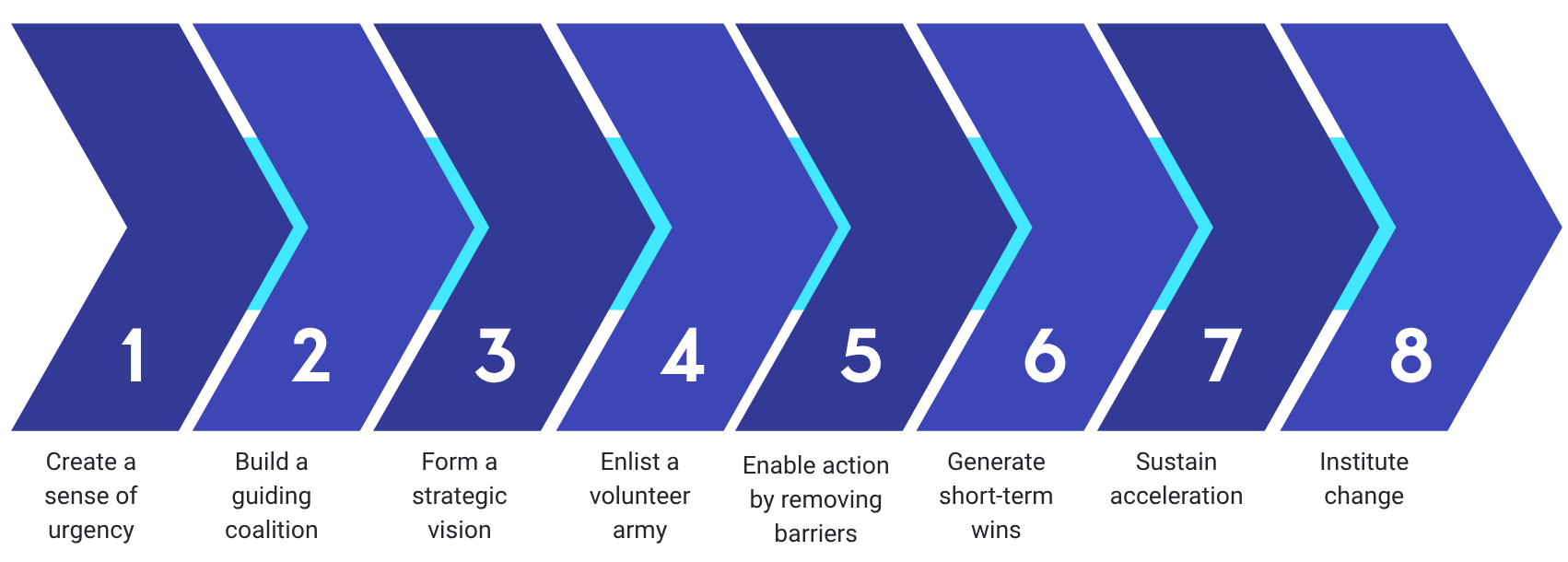 Kotter’s model provides a structured sequence that guides organisations from early awareness through to embedding change within the business.
Its strength is in building momentum. Focusing on urgency and leadership engagement, it creates the conditions needed for change to take hold. Early emphasis on forming a guiding group also ensures that responsibility for the change is shared rather than concentrated in a single role.
Communication is central throughout the process, helping to maintain alignment as the initiative progresses, and regular reinforcement of the vision supports consistency, which is most useful in larger organisations where messages can become diluted over time.
The model can feel structured in a way that may require adjustment in complex environments, where change does not always follow a predictable path. It is very effective for large transformation initiatives, where direction from leadership needs to be clear and sustained, and where retaining engagement over a longer period is essential.
ADKAR model
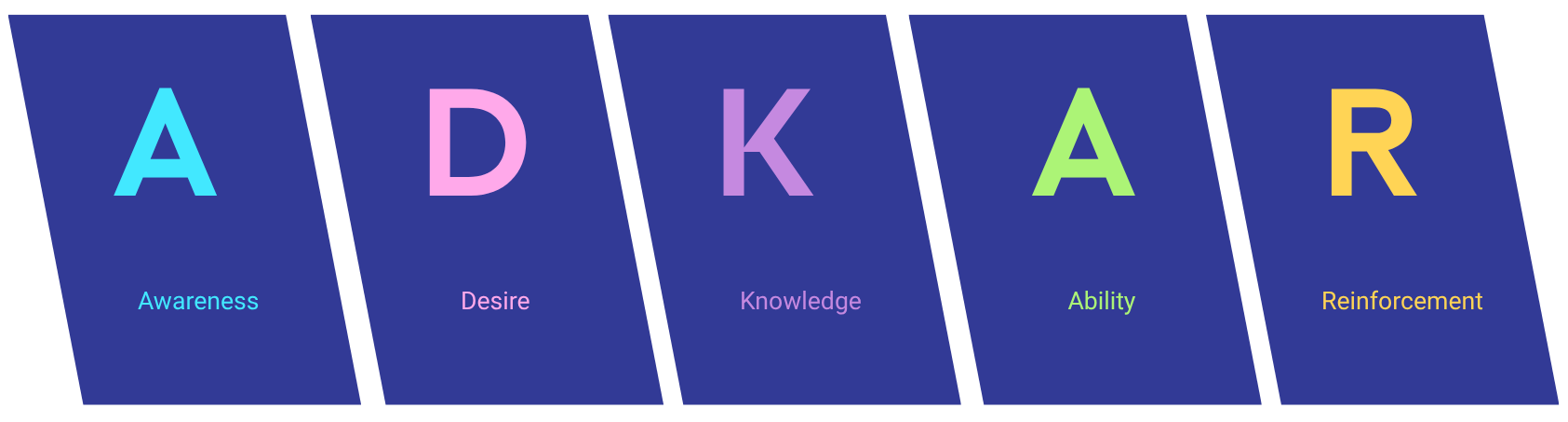 The ADKAR model focuses on individual experience, recognising that organisational change depends on how people adopt new ways of working.
It breaks change into stages that reflect how individuals move through transition, making it useful for identifying where resistance is occurring. This clarity allows leaders to focus their efforts more precisely, rather than applying broad solutions that may not address the root of the issue.
Its practical approach helps leaders to both diagnose issues and support individuals effectively. It also provides a useful framework for tracking progress, as each stage can be assessed to understand how well the change is being absorbed.
The limitation is that it places less emphasis on the broader organisational context, so it is often used alongside other frameworks when administering complex change. It is suited to initiatives where adoption is critical, such as system implementation or process change, particularly where success depends on consistent behaviour across teams.
For a more thorough exploration of the ADKAR model, take a look at our blog The ADKAR Model: What it is and how to apply it.
Lewin’s change model
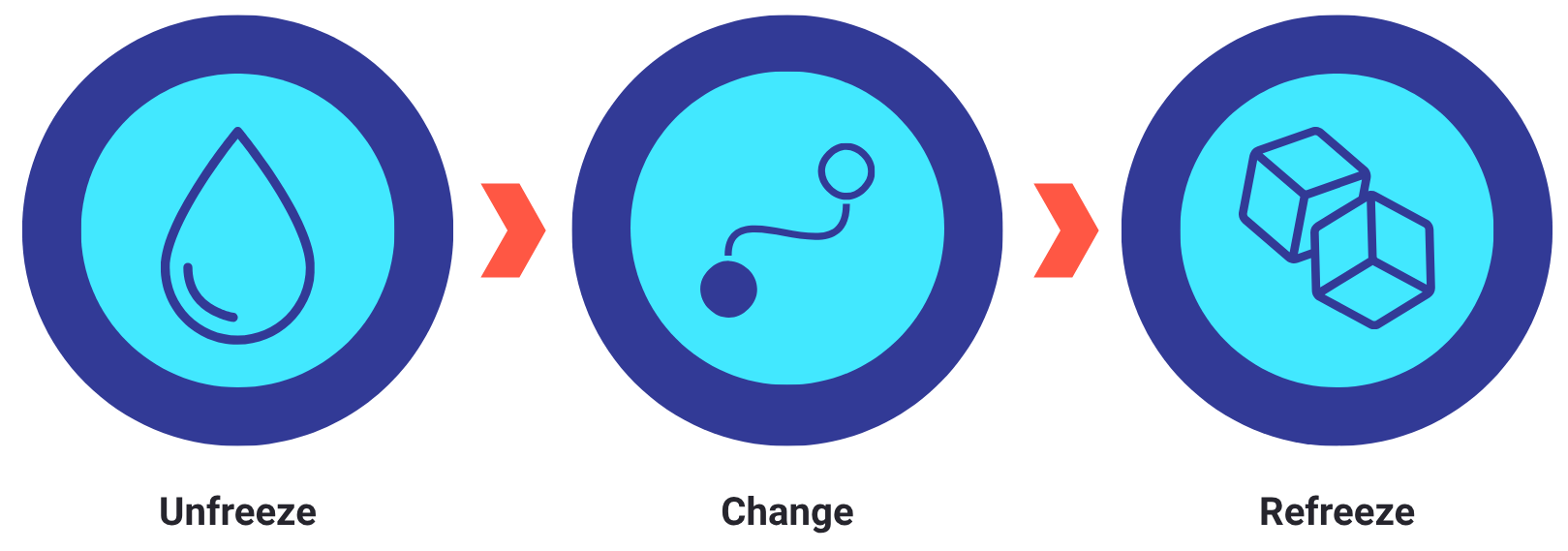 Lewin’s model presents change as a movement between states, and this perspective sometimes provides a clearer way for teams to understand the transition.
Its simplicity makes it accessible when communicating the concept of change across different levels of the organisation. By framing change as a shift from an existing state to a future one, it helps individuals to understand that preparation is required before new ways of working can take hold.
The model also highlights the importance of stabilising change once it has been introduced. Without this reinforcement there is a risk that teams revert to previous behaviours, especially in situations where pressure encourages familiar ways of working.
However, this simplicity can also limit its application in more complex environments, where change may be ongoing rather than seen as a single transition. Lewin’s model is most effective when leaders are implementing change for clarity purposes, notably for smaller-scale initiatives, or where the focus is on preparing teams for change.
McKinsey 7-S model
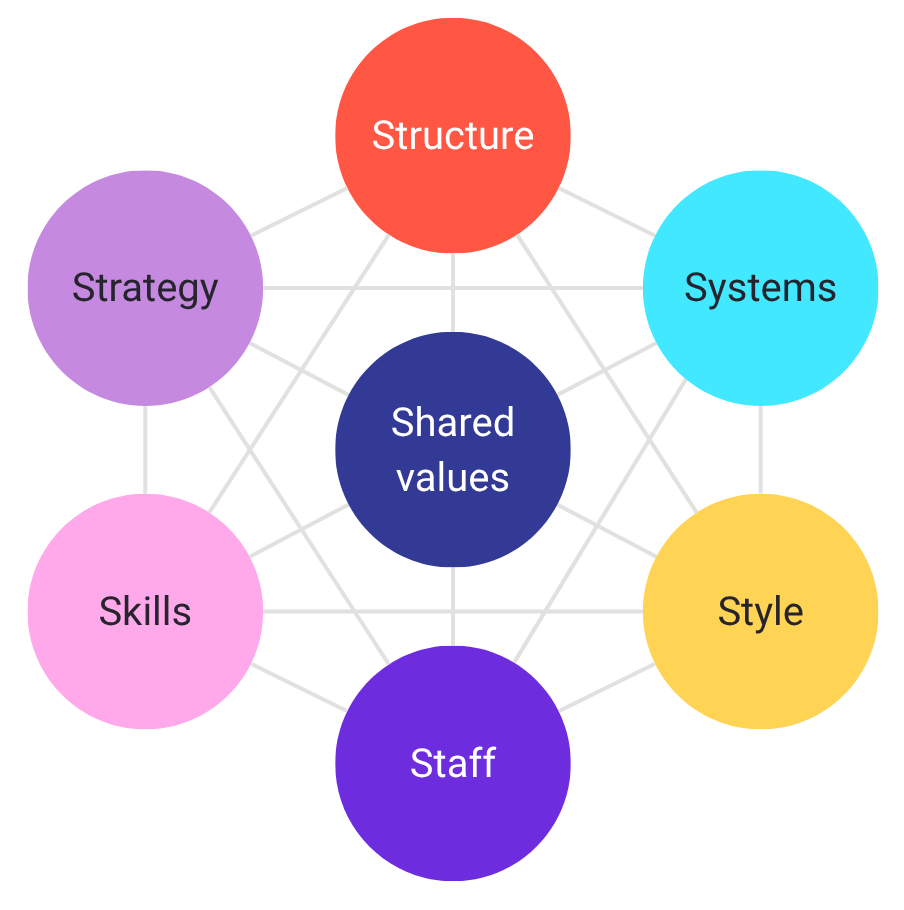 The McKinsey 7-S model takes a broader organisational view of change, focusing on how different internal elements align to support performance. Rather than concentrating on a sequence of steps, it encourages leaders to consider how structure, systems and ways of working connect across the organisation.
A key strength of this model is its emphasis on alignment. It highlights that change in one area will often have implications elsewhere, preventing unintended consequences during transformation. This makes it useful when organisations are adjusting strategy or restructuring operations.
The model also draws attention to less tangible factors, such as leadership style and organisational culture. These elements are often overlooked, yet they can have a significant influence on whether change is accepted or resisted.
One limitation is that the model does not prescribe a clear path for implementation. It provides a framework for analysis rather than a step-by-step guide, which means it relies on strong judgement from those applying it.
The McKinsey 7-S model is most effective when used to assess organisational readiness or to diagnose misalignment before change begins, but it also supports ongoing transformation by helping leaders identify where adjustments are needed as the organisation evolves.
Nudge theory
Nudge theory provides a different perspective on change, as it focuses on small influences that form behaviours over time. Instead of directing individuals through formal change management processes, it encourages subtle adjustments and adaptations to the environment to gently move decision-making in the desired direction.
This approach is pertinent when resistance is low, but you need engagement to increase. By making preferred behaviours easier or more visible, organisations can encourage adoption without relying on formal enforcement.
A key advantage is its flexibility. Nudges can be applied in a wide range of contexts, from encouraging use of new systems to supporting changes in everyday working practices. Because the approach is often low-cost, it can be introduced quickly and refined as needed.
Nudge theory works best when applied carefully. It does not replace structured change management frameworks or tools, and its impact may be limited if underlying concerns are not addressed, so is most effective when used alongside other models that provide a clearer framework for managing change.
Nudge theory is most useful for behavioural change initiatives, especially when the goal is to influence habits or encourage gradual adoption. It can also complement larger transformation programmes by reinforcing desired behaviours in a practical and unobtrusive way.
Choosing the right model
Selecting the right model depends on the type of change being introduced and the level of complexity involved.
Large transformation programmes often require a structured approach that provides direction, while initiatives that rely on adoption may benefit from a focus on individual experience.
In practice, many organisations draw from multiple models, combining elements to reflect their unique challenges. The key is to discern and apply the framework(s) that support the situation, rather than following them too rigidly.
Strengthening change capability
Change management models provide valuable guidance, yet their effectiveness depends on how they are applied in practice and how well they reflect the context of the organisation.
For professionals responsible for delivering change, understanding when to use each approach supports more confident decision-making and improves outcomes. Structured models such as Kotter or ADKAR offer clear direction, while broader frameworks like the McKinsey 7-S model help assess alignment across the organisation.
Approaches such as nudge theory can also play a role by reinforcing behaviour in subtle ways, supporting adoption once change is underway.
Used together when appropriate, these perspectives allow organisations to manage both the structural and human aspects of change without relying on a single method. This creates a more flexible approach that can adapt as priorities evolve.
Take a look at our Change Management training to build the skills required to support effective organisational transitions in real-world environments.