Over 40% off PRINCE2 virtual, 15% off eLearning - use code: NSWOCT26UAE

19 May 2026
Understanding the ITIL® (Version 5) Service Value System
As ITIL® continues to evolve with the launch of Version 5, one of its most important components remains the Service Value System. This concept brings together the elements required to deliver value th...

As ITIL® continues to evolve with the launch of Version 5, one of its most important components remains the Service Value System. This concept brings together the elements required to deliver value through services, offering a structured way to connect strategy with execution.
For organisations managing complex service environments, the Service Value System provides clarity. It explains how different components interact and how value is created through coordinated activity.
Understanding how this system works is essential for professionals looking to improve service management and align delivery with organisational goals.
What is the ITIL Service Value System?
The ITIL Service Value System describes how all components of an organisation work together to enable value creation. It provides a model that connects governance, practices and continual improvement within a single framework.
Rather than focusing on isolated processes, the system takes a holistic view, recognising that value is created through the interaction of multiple elements, each contributing to the overall outcome.
At its core, the Service Value System ensures that every activity is aligned with organisational objectives. It’s this alignment that maintains consistency across services and supports better decision-making.
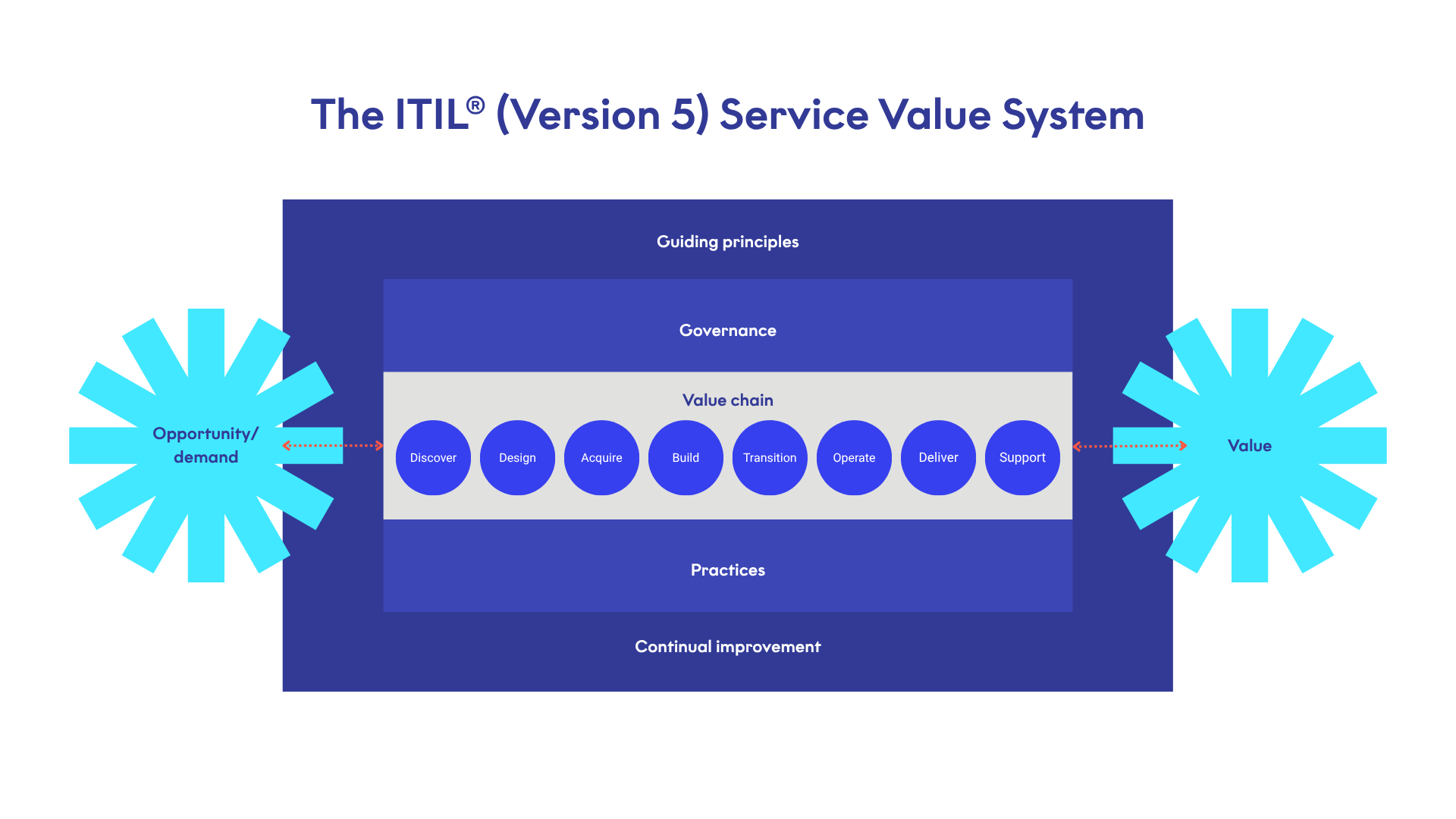
How the Service Value System fits within ITIL
The Service Value System sits at the centre of the ITIL framework. It brings together key elements that support effective service management, including guiding principles and governance, supported by continual improvement, with each of these elements playing a role in shaping how services are delivered.
Governance ensures that decisions are aligned with strategy, while the guiding principles support consistent behaviour across teams. Continual improvement ensures that services evolve over time, encouraging organisations to review performance and adapt where necessary, thereby maintaining relevance in changing environments.
By connecting these elements, the Service Value System provides a clear structure for managing services in a coordinated way.
Understanding the Service Value Chain
At the heart of the ITIL Service Value System is the Service Value Chain. This model shows how work moves from initial demand through to service delivery and ongoing support.
The diagram below presents the value chain. This reflects how work typically flows through service environments, with each stage representing a clear step in the progression from idea to outcome.
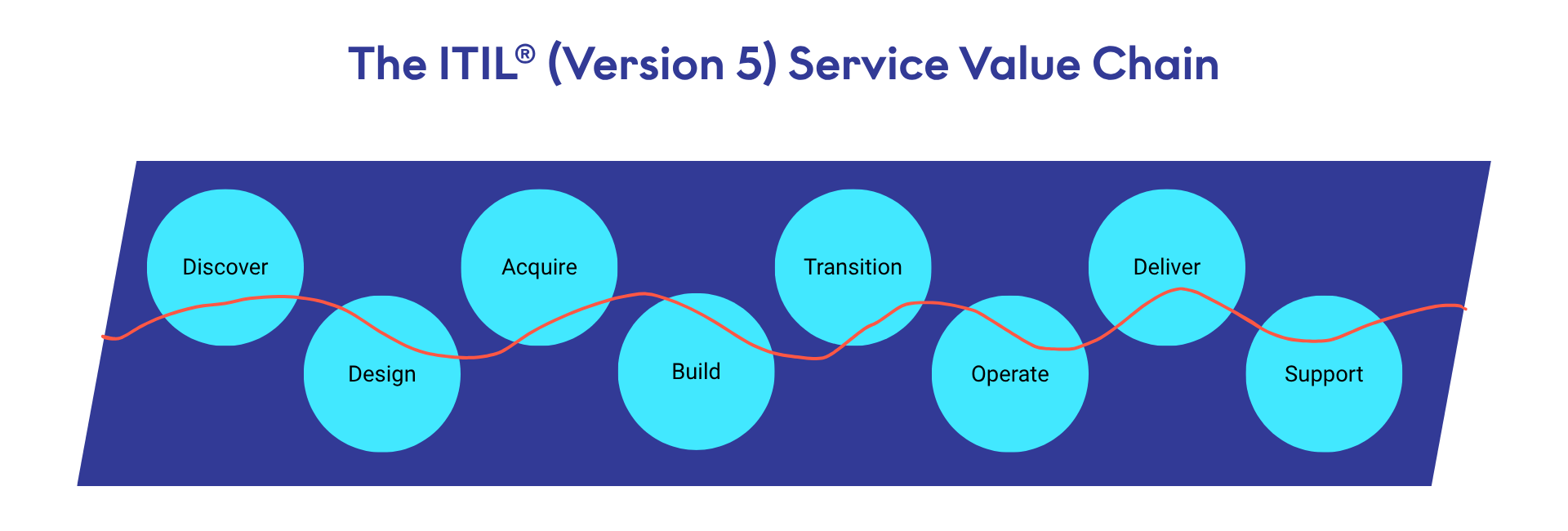
Each stage contributes to value creation by supporting a specific part of the service lifecycle:
- Discover – Identifies needs or opportunities and helps define the purpose of the work
- Design – Shapes how the service will meet requirements and sets a clear direction for delivery
- Acquire – Secures the resources or capabilities needed to support the service
- Build – Develops the components required to deliver the solution
- Transition – Introduces the service into use in a controlled and managed way
- Operate – Maintains the service in day-to-day use, ensuring it performs as expected
- Deliver – Ensures the service is provided to users in line with agreed expectations
- Support – Assists users and resolves issues to maintain effective service use
By presenting the value chain in this way, the model becomes easier to apply across different environments. It highlights how each stage connects to the next, while still allowing organisations to adapt the process to their own context, supporting flexibility without losing clarity. This structure supports flexibility without losing clarity. Teams can see how work progresses and identify where delays may occur which makes it easier to adjust activity and improve overall flow.
How the Service Value System improves service management
The Service Value System supports more effective service management by creating a clear link between strategy and delivery.
One of its main strengths is alignment; when all components operate within a shared framework, it becomes easier to ensure that services support organisational goals. It also improves visibility. By understanding how activities connect, leaders can identify where delays or inefficiencies occur. This allows for more targeted improvements.
Another benefit is adaptability; by supporting ongoing refinement, the system enables organisations to respond to changing requirements without losing structure.
These advantages make the Service Value System particularly valuable in environments where services must evolve quickly.
Applying the Service Value System in practice
Applying the Service Value System involves more than understanding its structure. It requires organisations to embed its principles into daily operations.
This begins with clear governance; decision-making should be aligned with organisational priorities, ensuring that services remain focused on delivering value. It also involves collaboration across teams. The Service Value System encourages a joined-up approach, where different functions work together rather than in isolation. Regular review is equally important. By assessing performance and identifying areas for improvement, organisations can refine how services are delivered over time.
In practice, this leads to more consistent outcomes and stronger alignment between service delivery and business needs.
Strengthening service delivery with ITIL
The ITIL Service Value System provides a practical framework for managing services in a structured way. By connecting governance, activities and improvement, it helps organisations deliver value more effectively.
For professionals working in service management, understanding this system is a key step in improving performance. It supports clearer decision-making and more coordinated delivery. As ITIL (Version 5) continues to develop, the Service Value System remains central to how organisations approach service management.
Explore ITIL training with ILX to deepen your understanding of the Service Value System and strengthen your approach to delivering value through services.